

June 1, 2026
Radmila
Cloud Migration & Hybrid Cloud
Listen
The Benefits of a Hybrid Cloud Approach Over Full Migration
For many businesses, cloud migration sounds like a simple decision: move everything to the cloud and leave the old infrastructure behind.
In reality, it is rarely that simple.
One company we worked with had been running most of its operations on on-premise infrastructure for years. Their systems were stable, familiar, and deeply connected to daily workflows. Internal applications, databases, file storage, user access, and backup processes had all been built around the existing environment.
But over time, the limitations became harder to ignore.
Maintenance was taking more effort. Hardware upgrades were becoming expensive. Remote access was not as flexible as the team needed. Scaling resources took too long, and every change required careful planning to avoid disruption. The business wanted more flexibility, better reliability, and a clearer path toward modernization.
At first, a full cloud migration seemed like the obvious choice.
But after reviewing the environment, it became clear that moving everything at once would create more risk than value. Some systems were ready for the cloud. Others still depended on local infrastructure, legacy integrations, or specific performance requirements.
So instead of forcing a full migration, we chose a hybrid cloud approach.
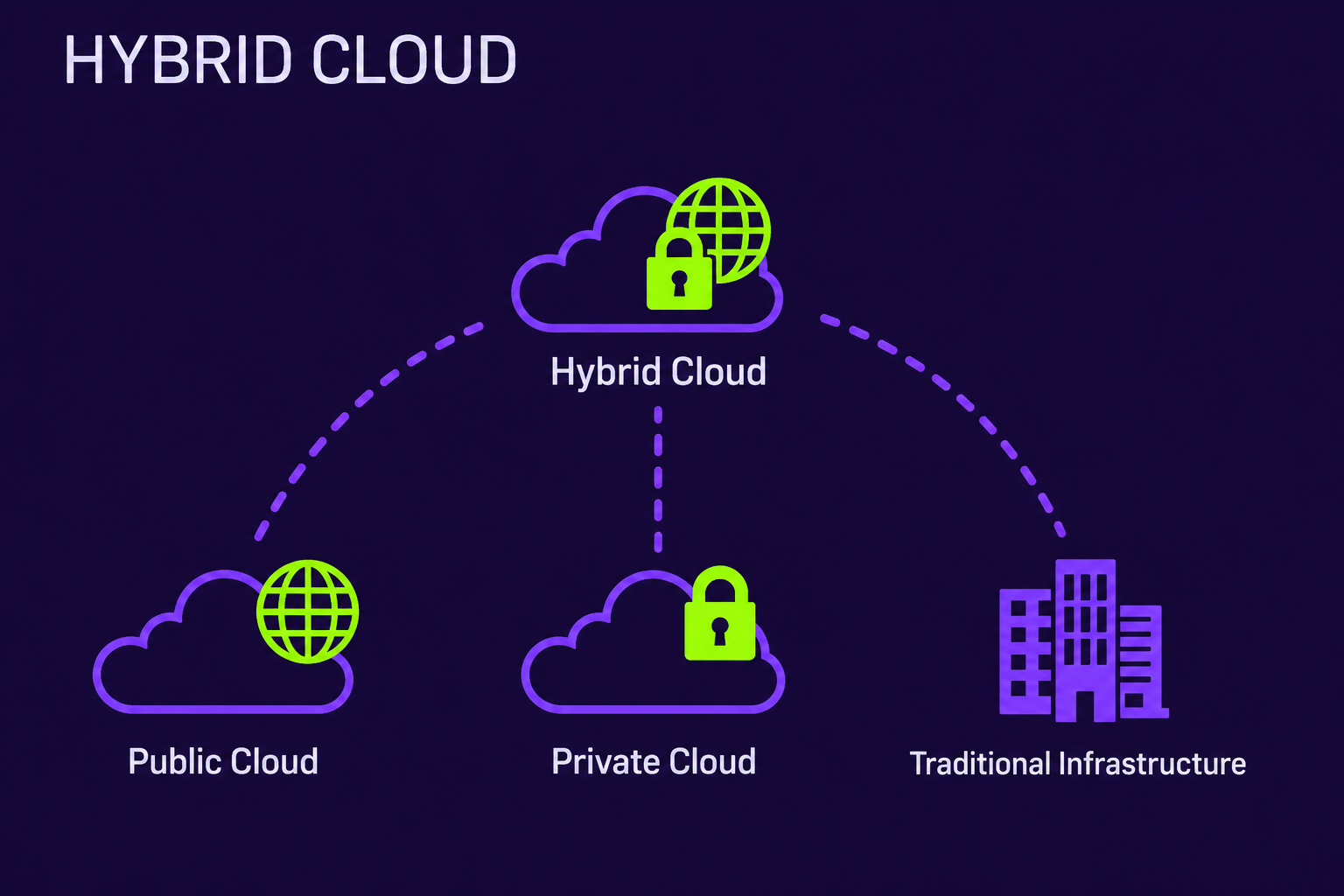
The company wanted to modernize without interrupting daily operations.
Their on-premise systems were still important, but they no longer gave the business enough flexibility. Teams needed better access to applications, stronger backup options, improved scalability, and a more reliable foundation for future growth.
The main challenge was balance.
Moving too slowly would keep the company tied to infrastructure limitations. Moving too fast could create downtime, compatibility issues, and unnecessary pressure on internal teams.
The better option was not to choose between on-premise and cloud. It was to connect them properly.
A hybrid cloud approach gave the company the best of both worlds.
Critical systems that still worked well on-premise could stay where they were. At the same time, cloud services could be introduced for workloads that needed more flexibility, scalability, or remote accessibility.
This allowed the company to modernize step by step instead of treating cloud migration as one massive project.
Before moving any workloads, we focused on cloud readiness. The company needed a clear foundation: the right architecture, access model, security setup, and migration priorities. That is where a structured Cloud Platform Kickstart (link) approach helped shape the first phase of the project.
Instead of rushing into migration, we first made sure the business had a cloud environment that was secure, scalable, and ready to support future workloads.
The first step was understanding the existing infrastructure.
We reviewed servers, applications, databases, access controls, backup processes, network dependencies, and business-critical workflows. The goal was not just to see what existed, but to understand what each system actually supported.
Some systems were good candidates for cloud migration because they needed better scalability or easier remote access. Others were better left on-premise for the time being because they were connected to legacy applications or internal processes that could not be changed quickly.
This assessment helped us avoid one of the biggest migration mistakes: moving systems just because they can be moved.
Cloud migration should solve a business problem. It should not create new ones.
Once the cloud foundation was prepared, the next step was connecting it properly with the existing on-premise infrastructure.
The goal was not to create two separate environments that the team had to manage independently. The goal was to make both sides work together as one connected system.
We designed a setup where selected cloud services could support the business while important on-premise systems continued running without disruption. This included secure connectivity, identity access, backup planning, monitoring, and clear rules for which workloads should stay local and which could move to the cloud.
This is where Hybrid Cloud Integration (link) became the key part of the strategy. It allowed the company to modernize gradually while keeping control over the systems that still needed to remain on-premise.
The result was a more flexible infrastructure model without forcing a risky full migration.
One of the biggest benefits of the hybrid approach was that the company did not have to stop everything to modernize.
Instead of planning one large migration window, we moved in phases.
First, we handled systems with lower risk and fewer dependencies. Then, as confidence grew, we moved more important workloads. This phased approach gave the team time to test, adjust, and understand the new environment before relying on it fully.
It also made troubleshooting easier.
If something needed to be changed, we could isolate the issue without affecting the entire business. That reduced pressure on both the technical team and the employees using the systems every day.
The transition became more controlled, less stressful, and easier to manage.
Security was a major part of the hybrid cloud design.
When infrastructure is split across on-premise and cloud environments, visibility can quickly become a problem. If systems are not connected properly, teams may struggle to monitor activity, manage access, or respond quickly when something goes wrong.
To prevent that, we reviewed identity management, permissions, network segmentation, encryption, backup policies, and monitoring. The goal was to make sure the hybrid environment did not introduce unnecessary risk.
We also focus on consistency.
Access rules needed to be clear. Backup processes needed to be reliable. Monitoring needed to cover both local and cloud-based systems. The company needed one clear view of its infrastructure, not a collection of disconnected environments.
This made the environment easier to manage and gave the team more confidence in the transition.
After the hybrid cloud setup was in place, the company gained more flexibility without losing control of its existing infrastructure.
Teams could access key services more easily. Backups became stronger and easier to manage. Infrastructure planning became more predictable. The company also had a clearer path for future cloud migration because the foundation was already prepared.
The biggest change was that modernization no longer felt like a risky all-or-nothing decision.
The company cloud moves at the right pace, based on actual needs rather than pressure to migrate everything at once. Workloads that made sense for the cloud could move forward. Systems that still needed to stay on-premise cloud remain stable.
That balance made the strategy more practical and more sustainable.
The hybrid cloud approach gave the company a smarter way to modernize.
Instead of forcing a full migration and risking disruption, the business gained a connected environment that supported both stability and growth. Critical on-premise systems continued running smoothly, while cloud services added the flexibility, scalability, and resilience the company needed for the future.
The result was not just a technical upgrade. It was a better operating model.
The team could move faster without losing control. Infrastructure decisions became easier to plan. Backups, access, and monitoring became more reliable. Most importantly, the company no longer had to choose between staying where it was and moving everything at once.
Hybrid cloud gave them a practical bridge forward.
It proved that modernization does not have to mean starting over. Sometimes, the best strategy is connecting what already works with what will help the business grow next.
Designing and developing digital experiences that move businesses forward.
Contact
hello@hoppsolutions.com
+49 155 1027 5723
+389 77 540 743
Office
Bul. Turisticka 21
6000 Ohrid, North Macedonia
Made with love by Hopp Solutions | 2026